When Is a Basic Trademark Search Not Enough?

Published on October 23, 2026
Estimated Read Time: 11 minutes

Key Takeaways
- Finding no identical trademark does not necessarily mean a brand name is available.
- Similar names can conflict because of their appearance, sound, meaning, or overall impression.
- Different trademark classes and industries do not automatically prevent conflicts.
- Earlier unregistered trademarks may create concerns that federal searches cannot identify.
- Broader research is particularly useful before launching, rebranding, or expanding a business.
- A trademark search helps identify risks but cannot guarantee USPTO approval.
Quick Answer: A basic trademark search is not enough when an exact-name check may miss similar names, sounds, logos, related products, or unregistered trademarks. A broader search helps uncover potential conflicts before you invest in branding or apply for federal registration.
Imagine spending months developing a business name, creating a logo, and preparing your first product launch. You search the USPTO database, find no identical trademark, and assume the name is available.
Later, you discover another business using a similar-sounding name for related products.
This situation illustrates why checking identical names is only one part of trademark clearance.
According to the United States Patent and Trademark Office (USPTO), likelihood of confusion with an existing registered trademark is one of the most common reasons applications are refused.
Likelihood of confusion means customers may mistakenly believe that goods or services offered under two different marks come from the same source.
Understanding what an initial search can miss helps you investigate potential conflicts before making significant decisions about your brand.
What Are the Limitations of a Basic Trademark Search?
A basic search can identify obvious matches, but it may not reveal trademarks that resemble your proposed name or exist outside federal registration records.
An exact-name check primarily determines whether the exact wording appears in the searched database. It does not necessarily evaluate every potential source of customer confusion.
Is an Exact Trademark Search Enough?
No. Two trademarks can be confusingly similar without being identical.
The USPTO considers similarities in appearance, pronunciation, meaning, and overall commercial impression, together with the relationship between the goods or services.
For example, an identical-word search may overlook names with alternative spellings or similar meanings.
The absence of an exact match should be treated as preliminary information, not confirmation of legal availability.
Basic Search vs. Broader Trademark Research
| Search Consideration | Exact-Name Search | Broader Research |
|---|---|---|
| Identical names | Primary focus | Included |
| Similar spellings and sounds | May be missed | Examines variations |
| Related goods or services | Not necessarily assessed | Reviews commercial relationships |
| Multiple classes | May be searched narrowly | Considers relevant classes |
| Similar logos | Not covered by text alone | May include design searches |
| Unregistered marks | Not found in federal records alone | Checks additional sources |
The value of a broader search lies in examining more potentially relevant information. It does not guarantee that every possible conflict will be identified.
6 Situations When a Basic Trademark Search Is Not Enough
Additional research becomes important when an existing trademark could resemble yours in ways that are not obvious from an exact-name search.
The following examples are hypothetical and illustrate different types of potential conflicts.
Your Brand Name Has Similar Spellings
Minor changes in spelling do not always distinguish trademarks sufficiently.
Suppose you want to sell skincare products under "BLOOMORA," while another business uses "BLUMORA" for similar products.
The wording differs, but customers might still perceive the names as closely related.
When researching a proposed name, consider:
- Added, removed, or substituted letters.
- Singular and plural forms.
- Combined or separated words.
- Alternative spellings and abbreviations.
The significance of a spelling difference depends on the overall impression of the marks and the relevant products or services.
Your Trademark Sounds Similar to Another Mark
Can similar-sounding trademarks cause a conflict? Yes.
Consider the hypothetical names "NITEGLOW" and "NIGHTGLOW" for related skincare products.
Although written differently, they sound alike when spoken. Customers hearing the name through a recommendation or advertisement may not recognize a distinction.
This is why phonetic searches matter.
Say your proposed brand name aloud, consider how someone might spell it after hearing it, and search reasonable alternatives.
Businesses do not need to sell identical products for similar trademarks to create possible confusion.
For example, a company selling facial cleansers may operate in a commercially related market to a company selling facial moisturizers.
Customers might reasonably believe those products come from the same source if they appear under confusingly similar marks.
The USPTO considers whether goods or services are related, including their typical sales channels, uses, and marketplace relationships.
Its likelihood-of-confusion guidance explains how these factors affect trademark examination.
A Similar Name Exists in Another Industry
Can a trademark conflict with a similar name in another industry? Yes, depending on the circumstances.
Different industries do not automatically eliminate trademark conflicts.
A fitness equipment business and a fitness coaching service, for example, may reach similar customers despite offering different products and services.
However, similar names can sometimes coexist when their offerings are sufficiently unrelated, and consumers are unlikely to assume a connection.
The important question is whether customers might believe the businesses share a commercial source, not simply whether they fall into different industry categories.
Your Logo Resembles an Existing Design
Can similar logos create a trademark conflict? Yes.
Trademark conflicts can involve graphical elements such as symbols, shapes, and arrangements.
Imagine two related businesses using distinctive mountain-shaped logos with a similar overall appearance.
Changing a small detail may not sufficiently distinguish the designs.
For visual searches, the USPTO provides design search codes that classify graphical elements.
The USPTO also describes a beta image-search feature in its Trademark Search system updates. This feature allows users to upload images to locate visually similar marks.
Image searching supplements traditional clearance research rather than replacing it.
Your Business Covers Multiple Trademark Classes
Do I need to search multiple trademark classes? Often, yes.
Trademark classes organize goods and services for registration, but they do not determine whether two marks can coexist.
For example, clothing generally belongs to Class 25, handbags to Class 18, and retail store services to Class 35.
Businesses offering these products or services may operate in related markets.
The USPTO recommends considering coordinated classes when researching potentially related offerings.
A different class number does not automatically make a mark available. Similarly, two marks in the same class do not necessarily create a conflict.
How Do I Search for Similar Trademarks?
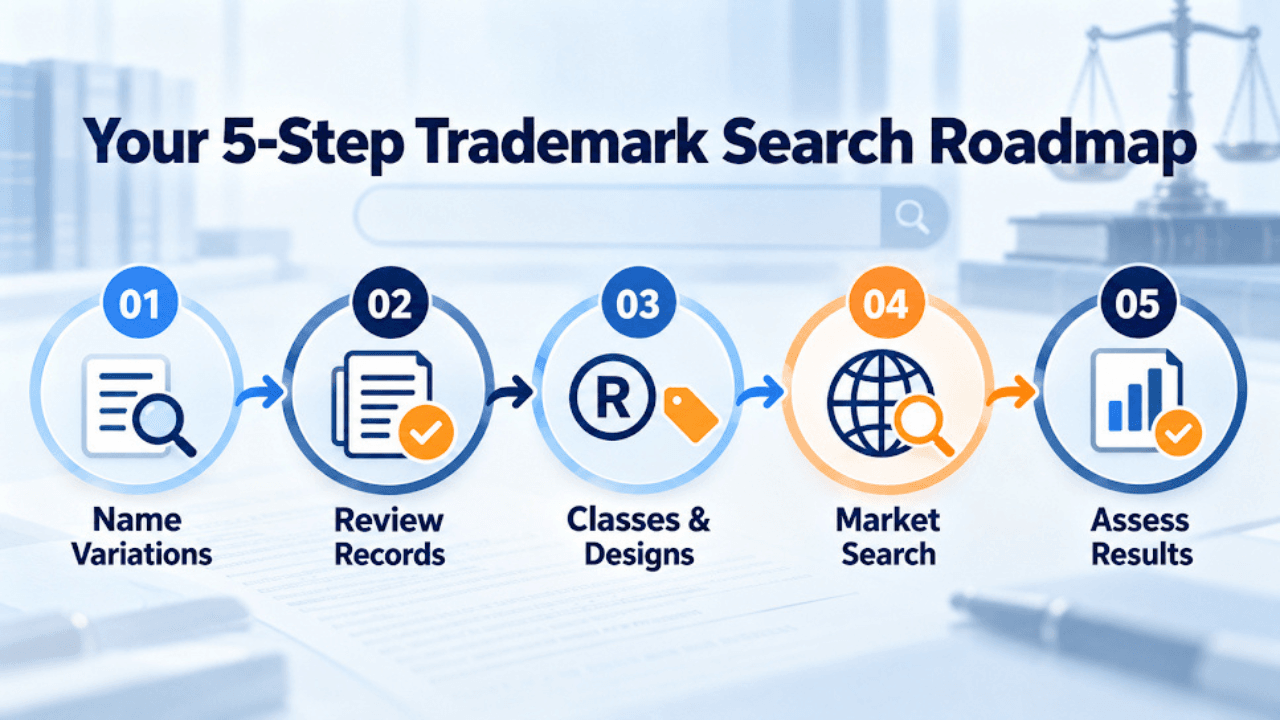
You can investigate potential conflicts by searching variations of your proposed mark, reviewing relevant federal records, and examining additional marketplace sources.
Start with the official USPTO Trademark Search system.
Step 1: Search Name Variations
Begin with the exact wording of your proposed trademark.
Then broaden the search to alternative spellings, similar pronunciations, and distinctive word combinations.
The USPTO's federal trademark searching guide explains how to use search fields and operators.
For example, its combined-mark field uses CM: to search of trademark wording. The guidance also explains ways to expand searches beyond exact matches.
Avoid restricting your search too quickly, especially when related marks may appear in other classes.
Step 2: Examine Potentially Relevant Records
When you discover a similar mark, review the actual record rather than relying on the search-results summary.
Check:
- The trademark's wording or design.
- Its listed goods and services.
- Its application or registration status.
- The owner and available filing information.
Focus on whether the marks and their offerings could create customer confusion.
Step 3: Investigate Designs and Related Classes
If your mark contains a logo, search its significant graphical elements.
Review classes covering your goods and services, along with classes associated with related offerings.
Searching only your intended class may exclude relevant marks used elsewhere.
Step 4: Check State Records and Marketplace Use
The federal database does not contain every trademark used in the United States.
Search relevant state trademark registries, business directories, websites, ecommerce marketplaces, and other sources showing commercial activity.
This research may identify common-law trademark rights, which can arise through qualifying use of a mark in commerce without federal registration.
The USPTO's comprehensive clearance guidance explains why searching beyond federal records matters.
Step 5: Assess the Search Results
Finding a similar mark does not automatically mean you cannot proceed.
Review how closely the marks resemble each other, whether their offerings are related, and whether earlier rights may be relevant.
An experienced U.S.-licensed trademark attorney can help interpret uncertain results and provide guidance on possible conflicts.
What Else Should You Know Before Filing?
Trademark clearance involves more than looking for matching names. A few distinctions can prevent common mistakes when interpreting search results.
A Business Name or Domain Registration Is Not Trademark Clearance
Registering an LLC name or securing a domain does not, by itself, establish that you can use the name without infringing another party's trademark rights.
Business-name availability and trademark rights involve different legal considerations.
Check how similar names are actually used in commerce before assuming your preferred name is available.
A Dead Trademark Record May Still Matter
An abandoned federal application or canceled registration generally cannot itself block registration based on that record.
However, the earlier mark may still be used in commerce and may have relevant common-law rights.
The USPTO's federal search guidance recommends focusing mainly on live records without completely disregarding dead ones.
A Search Cannot Guarantee Registration
A clear search does not guarantee that the USPTO will approve an application.
A trademark may face other registration issues, including descriptiveness or failure to function as a trademark.
Search results are one part of evaluating a proposed brand, not a final legal determination.
When Should You Consider a Broader Trademark Search?
Broader research is especially useful when you have selected a preferred brand name and are preparing to invest time or money in its launch.
It may also be appropriate when a preliminary search identifies similar marks that need further evaluation.
| Business Situation | Suggested Next Step |
|---|---|
| Comparing several potential names | Begin with preliminary screening |
| No exact federal match appears | Expand to similar marks and related offerings |
| A potentially similar mark appears | Investigate its record and commercial use |
| Launching an ecommerce business | Consider broader federal, state, and marketplace research |
| Investing in packaging or advertising | Review potential conflicts before committing |
| Expanding into new product categories | Examine related goods, services, and classes |
There is no single search depth suitable for every business.
When a proposed name is still one of several ideas, initial screening can help narrow the options. Once you are ready to build a business around that name, broader research becomes more valuable.
Trademark Engine's Comprehensive Trademark Search offers business owners the option to obtain additional information about potentially conflicting marks before filing.
A search report can help you identify issues for further consideration, although it cannot guarantee legal availability.
What Should You Do If You Find a Similar Trademark?
If a search identifies a potentially conflicting mark, examine the result before deciding whether to change your name.
Start by comparing the marks, their goods or services, and the available registration information.
If the results raise meaningful concerns, your options may include:
- Investigating the existing mark's commercial use.
- Modifying your proposed name or design.
- Choosing a different brand name.
- Seeking legal advice about the potential conflict.
The goal is to make a reasoned business decision rather than treating every similar result as an automatic obstacle.
Conclusion
A basic trademark search can reveal obvious matches, but it may not identify every potential conflict. Similar names, related products, logo designs, and earlier unregistered uses can require additional research.
Before investing in branding or submitting an application, consider the limits of your initial findings. A broader review can help you recognize potential concerns, evaluate your options, and make more informed decisions about the name you want to protect.
Explore Trademark Engine's Trademark Services
If you are ready to move forward with your proposed brand, explore Trademark Engine's trademark registration services to understand your filing options and available support.
Trademark Engine Editorial Team
Frequently Asked Questions
No. An exact-name search cannot identify every potentially conflicting mark. Similar sounds, spellings, designs, and unregistered uses may require additional research.
Yes. Marks with different spellings can still sound alike. If their goods or services are related, the similarities may contribute to a likelihood of confusion.
Sometimes. Similar names may coexist when the goods or services are sufficiently unrelated, and customers are unlikely to believe they come from the same source.
Review similar spellings, pronunciations, related goods and services, visual designs, relevant trademark classes, state records, and earlier unregistered marketplace use.
No. Search results do not guarantee registration. The USPTO may identify conflicting marks or other legal issues during examination.
Yes. Earlier qualifying commercial use can create common-law trademark rights without federal registration. The scope and effect of those rights depend on the circumstances.
Get Trademark Tips and Compliance Guidance
Subscribe for updates, insights, and resources that help you stay compliant and grow your mission.