What Does Trademark Monitoring Actually Track?

Published on October 13, 2026 | Updated on October 16, 2026
Estimated Read Time: 10 minutes

Key Takeaways
- Trademark monitoring watches for new filings that may overlap with an existing mark.
- Marks do not need to be identical to raise a possible likelihood-of-confusion issue.
- Similarity may involve wording, pronunciation, appearance, meaning, or commercial impression.
- Related goods and services are an important part of evaluating a potential conflict.
- A trademark search examines existing records; monitoring watches for later filings.
- The USPTO does not provide a private trademark-monitoring service.
Quick Answer: Trademark monitoring tracks new trademark filings that may be similar to an existing mark. It can flag similarities in wording, sound, appearance, commercial impression, and related goods or services. A monitoring alert signals something worth reviewing; it does not automatically establish trademark infringement.
Trademark monitoring helps business owners stay aware of new filings after their own brand is established. That matters in an active business environment: the U.S. Census Bureau recorded 531,728 business applications in August 2026.
More business applications do not automatically mean more trademark disputes, but they show how quickly new names, products, and brands continue to enter the market. This guide explains what trademark monitoring tracks, how it works, what types of similarities it may detect, and what a business owner should review when a potentially conflicting application appears.
What Is Trademark Monitoring?
Trademark monitoring is the ongoing process of watching for new trademark applications that may be relevant to an existing mark.
Instead of conducting the same search manually at regular intervals, a monitoring service reviews new filings over time and flags applications that meet its watch criteria.
For a small business, the basic purpose is straightforward: monitoring helps answer “Has something new been filed that may be too close to my mark?”
This is different from trademark enforcement. Monitoring identifies potential issues; it does not decide whether infringement has occurred or automatically take action against another applicant.
What Does Trademark Monitoring Track?
Trademark monitoring generally tracks new applications and compares them with the monitored mark. A useful watch looks beyond identical wording because trademark conflicts can involve several types of similarity.
The USPTO explains that trademarks need not be identical to be confusingly similar. Marks may be similar in sound, appearance, meaning, or overall commercial impression. The relationship between the associated goods or services also matters.
| Monitoring Signal | What It Can Help Identify |
|---|---|
| New trademark applications | Later-filed marks that may affect your brand |
| Exact wording | Applications using the same name or phrase |
| Similar spelling | Variations that look alike without being identical |
| Similar pronunciation | Differently spelled marks that may sound alike |
| Similar appearance | Marks with comparable visual elements |
| Similar meaning | Marks that communicate a similar idea |
| Commercial impression | Marks that may create a similar overall impression |
| Related goods or services | Applications operating in commercially connected areas |
| Application status | Where a relevant filing stands in the USPTO process |
New Trademark Applications
New applications are the main focus of a traditional trademark filing watch.
Once a mark is being monitored, later applications can be checked against it. A potentially relevant application may then appear in an alert or monitoring report.
This gives the owner a way to stay aware of new filings without relying only on occasional manual searches.
Similar Names, Spellings, And Sounds
Monitoring should not be treated as an exact-name search.
For example, suppose you own NORTHVALE for athletic clothing. A later application for NORTH VAIL covering similar products could deserve review because the two marks may sound alike even though their spelling differs.
The USPTO specifically recognizes similarity in sound, appearance, meaning, and commercial impression when evaluating possible conflicts.
Related Goods And Services
The wording of the mark is only part of the analysis.
The USPTO also considers whether the goods or services are related closely enough that consumers could believe they come from the same source. The goods do not need to be identical.
That is why monitoring results should be reviewed in context rather than judged only by the name.
What Can Trademark Monitoring Detect?
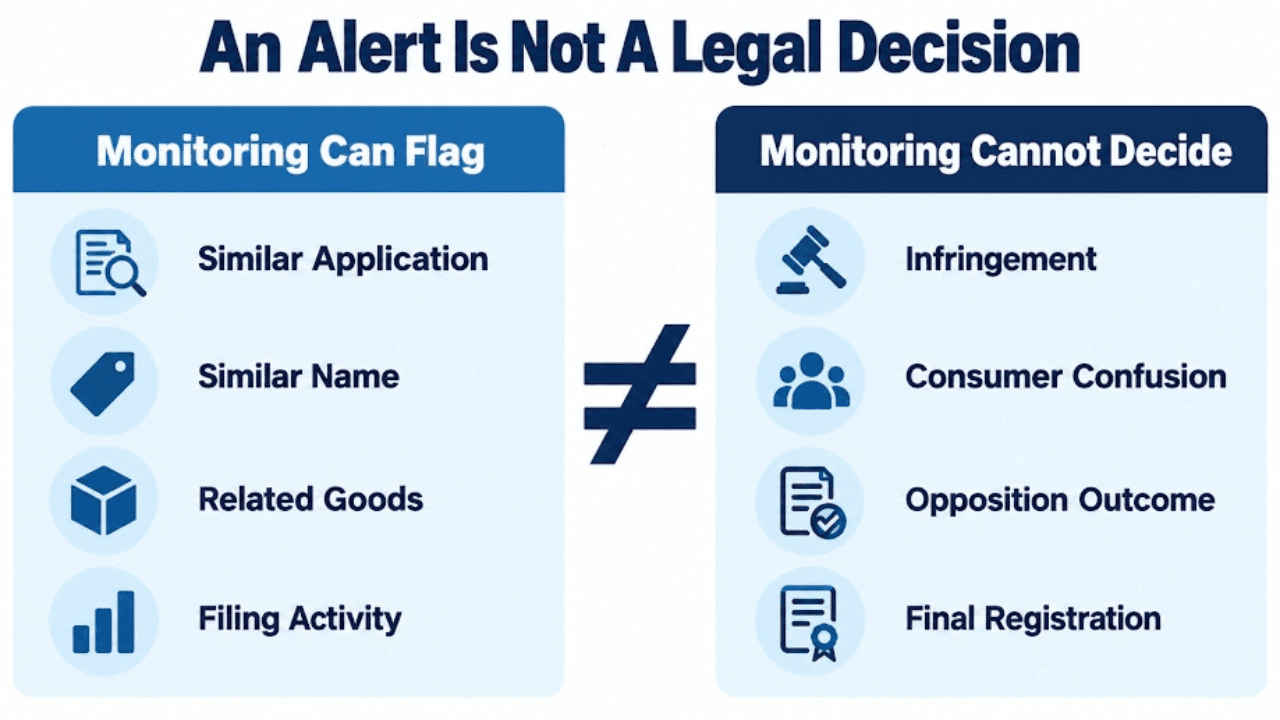
Trademark monitoring can help identify filing activity that deserves attention, including:
- Identical or closely related wording;
- Spelling variations;
- Similar pronunciation;
- Visually similar elements;
- Similar meanings or commercial impressions;
- Related goods or services; and
- Application or publication developments.
For design marks, federal trademark searching has also become more visual. In 2026, the USPTO introduced AI-assisted image search capabilities to help users find marks with similar design elements.
The important distinction is that detection is not a legal conclusion.
| Monitoring May Identify | Monitoring Does Not Automatically Decide |
|---|---|
| A potentially similar application | Whether infringement occurred |
| A similar name or design | Whether consumers are actually confused |
| Related goods or services | Whether an opposition would succeed |
| A filing worth reviewing | Whether the USPTO will ultimately register it |
A watch narrows the field. It helps you decide which filings deserve human review.
Does Trademark Monitoring Cover Websites, Domains, And Social Media?
Not necessarily. A trademark filing watch and broader online brand monitoring are different services.
A federal trademark watch may focus on new applications, similar marks, related goods or services, and developments in applications.
Broader brand-monitoring services may separately watch:
- Ecommerce marketplaces;
- Websites and online advertising;
- Domain registrations;
- Social media accounts; or
- Impersonation activity.
Before choosing a monitoring service, check exactly what sources it covers. Do not assume a filing watch automatically includes every online marketplace, domain, or social platform.
This scope distinction makes the phrase trademark monitoring explained more useful: the term can describe different levels of monitoring depending on the provider and service.
How Does Trademark Monitoring Work?
Trademark monitoring works by comparing new filings with the monitored mark and flagging results that meet defined similarity criteria.
The process usually follows five steps:
- Set The Mark To Monitor: The existing mark becomes the reference point.
- Review New Applications: Newly filed trademarks enter the monitoring process.
- Compare Relevant Similarities: The review may consider wording, spelling, sound, appearance, meaning, commercial impression, and associated goods or services.
- Flag Potential Matches: Applications meeting the watch criteria appear in an alert or report.
- Review The Result: The owner evaluates whether the filing needs further attention.
A monitoring alert may also include useful filing details such as the applicant, serial number, filing date, goods or services, trademark classes, and application status.
In simple terms:
Monitor → Detect → Review → Decide
What Happens When A Similar Trademark Is Found?
When a similar filing appears, review the application before assuming there is a conflict.
Compare The Marks
Look at the wording, sound, appearance, meaning, and overall commercial impression.
A shared word does not automatically create a conflict, just as different spelling does not automatically eliminate one.
Compare The Goods Or Services
Ask whether the products or services are commercially related.
The USPTO considers both the similarity of the marks and the relationship between the goods or services when assessing likelihood of confusion.
Check The Application Stage
The filing's status can affect what options are available.
After the USPTO approves an application for publication, it appears in the weekly Trademark Official Gazette. Publication begins a 30-day opposition period during which a person who believes registration would harm them may file a Notice of Opposition.
Not every similar mark requires an opposition or other legal response. The purpose of monitoring is to provide information early enough for the owner to make an informed decision.
New trademark applications can appear at any time. Trademark Engine helps you monitor potentially similar filings so you can review relevant developments without relying only on manual searches.
Does The USPTO Notify Trademark Owners About Similar Trademarks?
No. The USPTO does not provide a private trademark-monitoring service that continually sends owners personalized alerts about similar new filings.
The agency specifically states that it does not provide trademark monitoring or similar services.
The USPTO does search its federal records for conflicting marks when examining a new application. An examining attorney may refuse an application when the mark is sufficiently similar to an earlier registered or pending mark and the goods or services are related.
That examination process is different from monitoring an individual owner's trademark on the owner's behalf.
What Is The Difference Between Trademark Monitoring And Trademark Search?
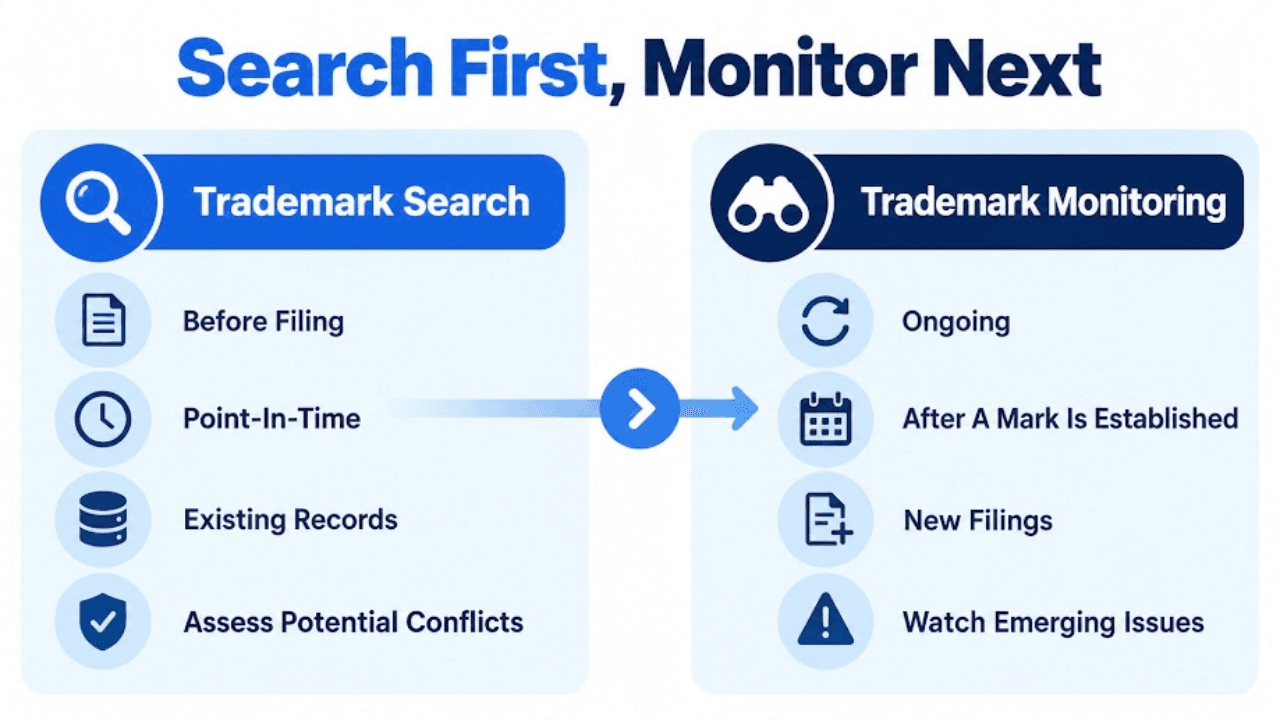
A trademark search investigates potential conflicts that already exist. Monitoring looks for relevant filings that appear later.
| Trademark Search | Trademark Monitoring |
|---|---|
| Usually performed at a specific point in time | Continues over time |
| Common before filing | Often used after a mark is established |
| Reviews existing trademark records | Watches newly filed applications |
| Helps assess potential availability | Helps identify emerging conflicts |
| Answers “What already exists?” | Answers “What appeared next?” |
The USPTO recommends conducting a comprehensive clearance search before filing because potentially conflicting marks can create registration problems.
The distinction is easy to remember:
Search helps you understand what already exists. Monitoring helps you stay informed about what appears afterward.
Do You Need Trademark Monitoring?
Trademark monitoring is optional, but it may be useful when your registered mark is important enough that you would want to know about potentially similar new applications.
It may be worth considering when:
- Your brand is central to your business;
- You sell nationally or online;
- You own several registered marks;
- Your market contains many similar names;
- You want earlier awareness of potentially conflicting filings; or
- Repeated manual searches are impractical.
The best monitoring approach depends on what you want to watch and how important the mark is to your business.
Conclusion
Trademark monitoring is an early-warning tool for new trademark activity. It can help you identify potentially similar filings and review whether they overlap with your mark, goods, or services. A monitoring alert is not proof of infringement; it is information that may deserve attention. A trademark search helps evaluate existing conflicts before filing, while monitoring helps you stay aware of relevant filings that appear later.
Stay Ahead of New Trademark Filings
Protecting your brand does not stop after registration. Trademark Engine can help you stay informed about new filings that may be similar to your registered mark, so you can review potential issues earlier.
Trademark Engine Editorial Team
Frequently Asked Questions
A trademark watch generally monitors new applications that may be similar to an existing mark. Depending on the service, it may consider wording, pronunciation, appearance, commercial impression, related goods or services, and filing status.
Monitoring compares newly filed trademarks with a mark being watched. Applications that meet the watch criteria may be flagged so the owner can review their similarity, goods or services, and status.
Review the marks, the associated goods or services, and the application's current status. A monitoring match does not automatically establish infringement or mean that legal action is required.
No. The USPTO examines applications for conflicts, but it does not operate a private monitoring service that continually sends trademark owners personalized alerts about similar filings.
A trademark search reviews existing marks at a point in time, usually before filing. Trademark monitoring is ongoing and watches for potentially relevant applications filed later.
Get Trademark Tips and Compliance Guidance
Subscribe for updates, insights, and resources that help you stay compliant and grow your mission.