Can You Trademark a Geographic Name? Rules for Place-Based Business Names

Published on November 19, 2026 | Updated on November 20, 2026
Estimated Read Time: 12 minutes
Key Takeaways
- City, state, and regional names may qualify for trademark protection under certain conditions.
- Geographic descriptiveness can create barriers to federal registration.
- A misleading geographic origin may prevent registration when it materially affects buyers.
- Distinctive wording can strengthen a place-based business name.
- Consumer recognition may help establish acquired distinctiveness.
- A comprehensive trademark search can uncover potential conflicts before filing.
Quick Answer: Yes, you can trademark a geographic name if it qualifies as a source-identifying mark. However, the USPTO may refuse names that primarily describe geographic origin. Some descriptive names can gain protection through acquired distinctiveness, while materially misleading names face stricter restrictions.
Choosing a place-based business name can strengthen your local identity, but it may also raise trademark concerns. According to an April 2026 USPTO report, the agency received 431,734 trademark application classes during the first half of fiscal year 2026, a 7% increase from the same period in FY2025.
With trademark filing activity rising, understanding registration requirements matters for growing businesses. Whether your brand includes a city, state, or regional name, eligibility depends on its meaning and how customers perceive it.
This guide explains geographic trademark rules, registration barriers, and practical ways to protect your brand.
Can You Trademark a Geographic Name Under U.S. Law?
A geographic name may qualify for federal trademark registration when consumers recognize it as identifying the source of goods or services rather than simply describing their geographic origin.
Under Section 2(e)(2) of the Trademark Act, the USPTO may refuse a mark that is primarily geographically descriptive.
For example, Denver Bakery may merely describe bakery services offered in Denver. A more distinctive brand incorporating the same location could create a different commercial impression.
The USPTO's Trademark Manual of Examining Procedure (TMEP), Section 1210, explains how geographic significance affects registration.
What Makes a Place-Based Name Eligible for Registration?
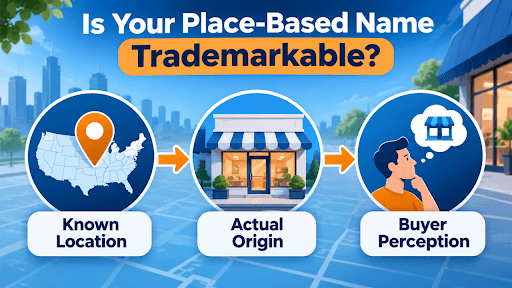
The USPTO generally considers three elements when assessing geographic descriptiveness:
- Geographic significance: Does the mark primarily identify a generally known location?
- Actual origin: Do the goods or services originate from that place?
- Consumer association: Would buyers likely believe the goods or services come from that location?
When these conditions apply, registration on the Principal Register may require evidence of acquired distinctiveness.
However, not every geographic reference is descriptive. An obscure location or a term with another primary meaning may receive different treatment.
Quick Geographic Trademark Assessment
Before choosing your business name, consider these questions:
- Is the named location widely recognized by your target customers?
- Does your business have a genuine connection to that location?
- Would customers interpret the wording mainly as geographic information?
- Does the name contain an original element that identifies your brand?
- Could the geographic reference give customers a misleading impression?
These questions provide an initial assessment, not a final determination of trademark eligibility.
Why Does the USPTO Refuse Certain Geographic Trademarks?
The USPTO may refuse registration when a name primarily describes the actual origin of goods or services or falsely suggests an origin that materially influences consumers.
These situations involve different legal standards.
Primarily Geographically Descriptive Marks
A mark may be primarily geographically descriptive when its main meaning identifies a generally known location where the goods or services originate.
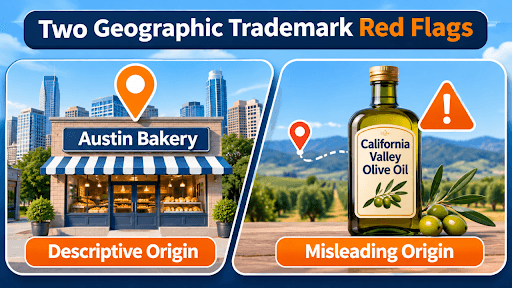
Consider a hypothetical business operating in Austin under the name Austin Bakery.
Customers may understand the wording as describing a bakery in Austin rather than identifying one particular business.
Under Section 2(e)(2), the USPTO may refuse registration of the mark on the Principal Register for lack of acquired distinctiveness.
Such a refusal does not necessarily prevent every form of federal registration.
Geographically Deceptively Misdescriptive Marks
Section 2(e)(3) addresses marks that falsely suggest geographic origin when the false association materially affects purchasing decisions.
Imagine a hypothetical olive oil brand named California Valley Olive Oil whose products do not originate in California.
The name may face refusal if consumers believe the oil comes from California and that belief materially influences their decision to purchase it.
The USPTO examines whether:
- The mark primarily identifies a known geographic location.
- The goods or services do not originate there.
- Consumers would likely associate them with that location.
- The false association would materially influence relevant consumers' purchasing decisions.
A mark refused under Section 2(e)(3) generally cannot overcome that refusal through acquired distinctiveness.
Geographic Trademark Eligibility Examples
Naming Situation | Potential Trademark Issue | Possible Next Step |
Name accurately describes business origin | Geographic descriptiveness | Assess secondary meaning |
Name falsely suggests a significant geographic origin | Geographic deception | Reconsider misleading wording |
City name combined with invented wording | Distinctiveness of the complete mark | Evaluate disclaimer requirements |
Obscure place name | Consumer recognition of the location | Research geographic significance |
Established geographic brand | Evidence of acquired distinctiveness | Gather customer-recognition evidence |
Can City, State, and Regional Names Become Protected Brands?
Yes. A city, state, or regional name may form part of a protected trademark when the complete mark identifies a commercial source and meets federal requirements.
However, trademark registration does not automatically grant exclusive ownership of the geographic term itself.
Combining Geographic Terms With Distinctive Branding

An original brand element may help a place-based name become more distinctive.
Consider Veloria Austin, a hypothetical clothing brand.
The invented word Veloria may help customers identify a particular business, while Austin communicates a geographic connection.
The USPTO may still require a disclaimer of geographic wording in an otherwise registrable mark.
A disclaimer means the owner does not claim exclusive rights to the disclaimed wording separately from the complete trademark.
Simply adding a generic word or decorative logo does not automatically overcome a geographic refusal.
Location-Based Names for Ecommerce Businesses
An ecommerce business can use geographic wording, but selling online does not eliminate the USPTO's geographic trademark rules.
Consider Brooklyn Threads, a hypothetical clothing company operated by a founder in Texas.
The USPTO may assess whether relevant customers recognize Brooklyn as a location, whether the goods originate there under applicable standards, and whether the name creates a misleading impression.
A founder's physical address alone may not determine the geographic origin of the goods.
Manufacturing, production, sales activity, and consumer perception can be relevant to that analysis.
Online sellers should therefore evaluate the accuracy of geographic references before investing in packaging, product labels, and advertising.
When Can a Geographic Name Gain Trademark Protection Through Use?
A primarily geographically descriptive name may qualify for Principal Register protection through acquired distinctiveness when consumers come to recognize it as identifying one commercial source.
This recognition is also called secondary meaning.
Evidence That Supports Acquired Distinctiveness

The USPTO may consider evidence such as:
- Substantially exclusive and continuous trademark use.
- Advertising that promotes the wording as a brand.
- Sales figures and commercial reach.
- Media coverage and public recognition.
- Consumer surveys or customer statements.
- Other evidence connecting the mark with one business.
Under Section 2(f), five years of substantially exclusive and continuous use may support a claim of acquired distinctiveness in some circumstances.
However, five years of use does not automatically establish eligibility. The USPTO may require additional evidence depending on the mark.
See the USPTO's acquired-distinctiveness guidance.
What the Newbridge Cutlery Case Shows
In re Newbridge Cutlery Co., 776 F.3d 854 (Fed. Cir. 2015), the Federal Circuit examined the geographic descriptiveness of NEWBRIDGE HOME.
The USPTO had relied on the existence of Newbridge, Ireland, when evaluating the mark.
The court found insufficient evidence that relevant U.S. consumers would primarily recognize Newbridge as a geographic location.
The decision illustrates a key principle: a place's existence does not automatically establish that its name is primarily geographic to relevant American consumers.
Principal Register vs. Supplemental Register
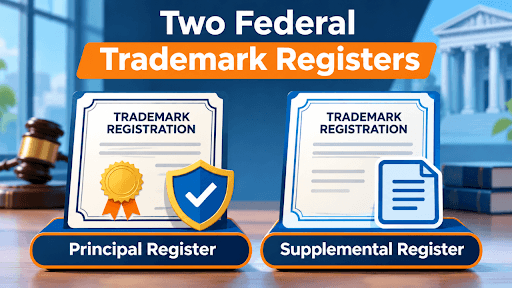
Certain geographically descriptive marks may qualify for the Supplemental Register when they lack sufficient distinctiveness for the Principal Register but can potentially identify a commercial source.
Principal Register | Supplemental Register |
Generally requires inherent or acquired distinctiveness | May accept qualifying descriptive marks |
Provides statutory presumptions associated with federal registration | Does not provide the same statutory presumptions |
Offers broader registration benefits | Provides certain federal registration benefits |
May be available after secondary meaning develops | May be available before sufficient secondary meaning develops |
The Supplemental Register has specific eligibility and use requirements. It cannot be used to overcome every refusal, including a geographically deceptive refusal under Section 2(e)(3).
How to Trademark a Place-Based Business Name

To trademark a geographic name, evaluate its meaning, investigate existing rights, and prepare a federal application that accurately describes your goods or services.
These five steps can help.
Step 1: Evaluate Your Proposed Name
Determine whether the name mainly describes a location or creates a distinctive commercial impression.
If the wording is overly descriptive, consider adding an original brand element rather than relying solely on a city or state name.
Step 2: Verify Geographic Origin Claims
Check whether your proposed name accurately represents where your goods or services originate.
Review product packaging, website descriptions, and marketing materials for statements that could mislead customers.
Pay particular attention when the named location has a recognized reputation for your products.
Step 3: Conduct a Comprehensive Trademark Search
Before investing in your brand, research existing trademarks that may conflict with the proposed name.
The USPTO's comprehensive clearance search guidance recommends searching federal records and other relevant sources.
Your research should include:
- Identical and similar-sounding names.
- Alternative spellings and related wording.
- Pending and registered federal trademarks.
- State trademark and business records.
- Relevant unregistered marketplace uses.
Similar marks used for related goods or services.
An exact match is not required for a likelihood-of-confusion refusal.
Trademark Engine's article on when a basic trademark search is not enough explains why broader research may reveal conflicts missed by simple searches.
Step 4: Confirm Ownership and Filing Requirements
Before applying, identify the correct trademark owner, goods or services, classes, and filing basis.
Applicants may file based on qualifying current use in commerce or a bona fide intent to use the mark.
Business name registration is not federal trademark registration.
Registering an LLC, obtaining a DBA, or buying a domain name does not automatically establish federal trademark registration.
Qualifying commercial use may create trademark rights, while federal registration provides additional legal benefits.
The USPTO's base filing fee for Section 1 and Section 44 applications is $350 per class, with additional fees possible.
Review the current USPTO fee schedule before submitting your application.
Step 5: File and Monitor Your Application
Submit your application through the USPTO's Trademark Center.
An examining attorney will review the application and may issue an Office Action identifying legal or procedural concerns.
Respond within the applicable deadline and provide supporting evidence when requested.
For additional filing guidance, see Trademark Engine's article on how to trademark a name.
If your proposed name raises complex geographic issues, consider consulting an experienced U.S.-licensed trademark attorney.
Geographic Trademarks vs. Geographical Indications
A geographic trademark identifies the commercial source of goods or services, while a geographical indication identifies goods associated with a particular geographic origin and related qualities, characteristics, or reputation.
For example, a clothing company may use a distinctive trademark containing a city name. The trademark identifies the business behind its products.
A geographical indication serves a different purpose.
The USPTO identifies ROQUEFORT for cheese and DARJEELING for tea as examples involving geographic certification marks.
These marks can certify that products meet geographic-origin requirements rather than identify one ordinary commercial producer.
The USPTO's geographical indications guidance explains how U.S. trademark law protects these designations.
For most small businesses, the immediate concern is whether their chosen place-based name functions as a distinctive commercial trademark.
Conclusion
A geographic name can strengthen your business identity, but trademark protection depends on how customers understand it. The USPTO considers geographic significance, actual origin, distinctiveness, and potential conflicts with existing marks. Before filing, investigate similar trademarks and assess whether your name needs a stronger brand element. Choosing accurate, distinctive wording can support long-term brand protection while reducing avoidable registration problems as your business expands into new markets.
Check Your Geographic Business Name Before Filing
Before investing in branding, packaging, or advertising, research your proposed name for potential trademark conflicts.
Trademark Engine offers trademark search and registration services to help business owners explore their options and prepare for the federal application process.
Start with Trademark Engine's trademark search or registration tools to take the next step.
Registration decisions remain subject to USPTO examination, applicable requirements, and government filing fees.
Trademark Engine Editorial Team
Frequently Asked Questions
Yes, depending on their complete trademarks, goods or services, and existing rights. Businesses may use geographic wording descriptively, but similar overall marks can create legal concerns when customers are likely to confuse their commercial sources.
Not automatically. A distinctive logo may help a combined mark qualify for registration, but it does not necessarily grant exclusive rights to the geographic wording. Protection may apply to the complete mark rather than the place name alone.
Possibly. Eligibility depends on how the name functions in commerce and whether existing trademarks, official designations, or other restrictions apply. A landmark name should be researched individually before filing.
No. An individual may apply for federal trademark registration without forming an LLC. However, the application must identify the correct legal owner and meet the applicable USPTO filing requirements.
Yes. Qualifying trademark use may create common-law rights without federal registration. These rights depend on actual commercial use and other circumstances and may offer narrower geographic protection than federal registration.
Often, yes, but the way the name appears matters. A city name printed as decoration may not function as a trademark. Source-identifying uses, such as appropriate branding on labels or tags, may receive different treatment.
Get Trademark Tips and Compliance Guidance
Subscribe for updates, insights, and resources that help you stay compliant and grow your mission.